


In any given year, roughly one in five Australian property transactions happens without a public listing. No Domain ad. No realestate.com.au profile. No open home.
These are off-market sales, and they represent one of the most significant structural advantages available to property investors who know how to access them.
This guide explains what off-market properties are, why they exist, how to find them, and why they matter more in a supply-constrained market like Australia in 2026.
An off-market property is one that is available for sale but has not been publicly advertised on major listing portals. The vendor has decided to sell, an agent is typically involved, but the property is offered quietly to a select group of buyers rather than being marketed broadly.
There is also a related category called pre-market, where a property is being prepared for public listing but has not yet gone live. During this window, buyers with the right relationships can inspect and make offers before the general market sees the property.
Both categories share one thing in common: access is limited to buyers who are connected to the right networks.
Research from Listing Loop estimates that approximately 20% of Australian property transactions occur off-market. That figure is a national average. In certain segments, the proportion is significantly higher.
In prestige markets, particularly in tightly held suburbs across Sydney's Lower North Shore, Eastern Suburbs, and inner Melbourne, industry estimates suggest up to 40% of sales happen off-market. Privacy is the primary driver at this end of the market: high-net-worth vendors often prefer to avoid public scrutiny of their assets and sale prices.
But off-market is not just a prestige phenomenon. In supply-constrained markets across Brisbane, Perth, and Adelaide, agents increasingly use off-market channels to test buyer interest before committing to a full marketing campaign. This creates opportunities for investors at every price point, including the $500,000 to $1.5 million range where the majority of investment-grade houses sit.
Understanding vendor motivation is critical for any buyer looking to capitalise on off-market opportunities. There are several common reasons.
Some vendors do not want their neighbours, tenants, or business associates knowing they are selling. This is particularly common for investment property owners who do not want to unsettle existing tenants, and for vendors going through separation or financial difficulty.
A vendor who needs a quick sale may prefer to deal with a small pool of qualified buyers rather than running a 4 to 6 week marketing campaign. Off-market sales can settle in half the time of a publicly listed property because the buyer pool is pre-qualified and motivated.
A full marketing campaign for a residential property in Sydney can cost $5,000 to $15,000 in advertising fees alone. Selling off-market eliminates or significantly reduces this cost. For vendors who are price-sensitive or cash-constrained, this is a material consideration.
Some vendors and agents use the off-market channel to test price expectations before committing to a public campaign. If the property attracts a strong offer privately, it sells. If not, it goes to market with a refined pricing strategy.
In markets with limited listing volumes, agents may hold properties off-market because they know they can sell them through their buyer networks without the cost and effort of public advertising. This is increasingly common in Perth and Adelaide, where listing volumes remain well below historical averages.
For property investors, off-market access creates three distinct advantages.
A publicly listed property in a popular suburb might attract 30 to 50 inspection groups and multiple offers. An off-market property might be shown to 3 to 5 qualified buyers. Less competition typically means less emotional bidding and more rational pricing.
When a vendor sells off-market, they are trading the certainty of a broad marketing campaign for the speed and simplicity of a private deal. This changes the negotiation dynamic. The buyer is providing something the vendor values: a clean, fast transaction without the disruption of open homes and public marketing. That leverage, used correctly, can translate into a purchase price below what the property would achieve on the open market.
In fast-moving markets, timing matters. Off-market and pre-market access means you can inspect and make offers on properties before competing buyers even know they exist. In suburbs where quality stock is scarce and demand is high, this is the difference between securing a property and missing out entirely.
Off-market properties are, by definition, not easy to find. That is what makes them valuable. But there are several channels that consistently produce results.
Selling agents are the primary gatekeepers of off-market stock. When they secure a new listing that the vendor wants to sell privately, their first call goes to buyers they know, trust, and have dealt with before.
This works if you are an active buyer in a specific area. It does not work if you are an interstate investor who has never met the local agents and is competing for attention with dozens of other enquiries.
Building these relationships takes time, consistency, and local presence. You need to be known as a serious buyer who can move quickly and settle reliably.
This is the most efficient path to off-market access for investors, particularly those buying interstate or in multiple markets simultaneously.
A buyers agent who operates regularly in a specific market has already built the agent relationships, network connections, and deal flow that an individual investor would need months or years to develop. They are on the call list. They see the properties before they go public.
At Handle Properties, off-market sourcing is a core part of our service. Our agent network across Sydney, Brisbane, Melbourne, Perth, and Adelaide gives clients access to properties that never appear on public portals.
Several platforms now aggregate pre-market and off-market listings. Listing Loop is the most established in Australia, connecting buyers directly with agents who have off-market stock. Some real estate agencies also maintain their own off-market buyer databases that you can register for.
The limitation of these platforms is that they are accessible to anyone who signs up. The best off-market deals, the ones where vendor motivation is highest and competition is lowest, still tend to flow through private agent-to-buyer relationships rather than platform listings.
Some investors and buyers agents identify target properties in specific streets or suburbs and approach owners directly with a purchase proposal. This is a high-effort, low-conversion strategy, but it can surface opportunities that no other channel reaches.
This approach works best in tightly held suburbs with low turnover, where the right property almost never comes to market through conventional channels.
The absence of public marketing does not mean the absence of due diligence. If anything, off-market purchases require more rigour because you do not have the price transparency that comes from public listings, competing offers, and auction results.
Never rely on the agent's price guide alone. Commission an independent valuation or build your own comparable sales analysis using recent settled prices in the same suburb and property type. Data from sources like Cotality (formerly CoreLogic), Pricefinder, or RP Data gives you an objective benchmark.
An off-market deal in the wrong suburb is still a bad investment. Apply the same data-driven suburb analysis you would use for any purchase: population growth, infrastructure pipeline, supply constraints, rental yield, and historical capital growth. Our analysis of the best suburbs to invest in for 2026 covers this framework in detail.
Off-market does not mean rush. Always complete a building and pest inspection before going unconditional. The speed advantage of off-market should come from faster decision-making, not from skipping due diligence.
Understanding why the vendor is selling off-market helps you calibrate your offer. A vendor selling for privacy reasons may have different price expectations than one selling for speed or financial pressure. Your buyers agent or your own research should give you this context.
Off-market is not automatically a better deal. Avoid these traps.
Assuming off-market means below market value. Some off-market properties are priced at or above market value. The vendor may be testing the waters or may simply want a private sale at full price. Always benchmark against comparable sales data.
Moving too fast without due diligence. The urgency of off-market can pressure buyers into skipping inspections, valuations, or proper suburb research. Speed is an advantage, but not at the cost of rigour.
Paying for access that does not exist. Be cautious of services that charge upfront fees for exclusive off-market access without demonstrating genuine agent relationships or deal flow. The best off-market access comes from established networks, not subscription databases.
What percentage of properties sell off-market in Australia? Approximately 20% of Australian property transactions occur off-market, according to research from Listing Loop. In prestige markets, this figure can reach 40%.
Are off-market properties cheaper? Not automatically. Off-market properties can be priced at, above, or below market value. The advantage is reduced competition and better negotiation dynamics, which can result in a lower purchase price, but this depends on vendor motivation and buyer strategy.
How do I find off-market properties in my area? The three main channels are building direct relationships with local selling agents, engaging a buyers agent with established networks, and registering on pre-market platforms like Listing Loop. The most effective approach is typically through a buyers agent who operates regularly in your target market.
Can I get a loan for an off-market property? Yes. The financing process is identical to any other property purchase. Your lender will require a valuation, which is conducted independently regardless of how the property was marketed.
Is it risky to buy off-market? The risks are the same as any property purchase. The key is maintaining the same due diligence standards: independent valuation, building and pest inspection, comparable sales analysis, and suburb research. Off-market access is an advantage in sourcing. It does not replace sound investment methodology.


Buying an investment property is not the same as buying a home. The criteria, the strategy, and the mistakes are completely different. Here is what most investors get wrong.
View More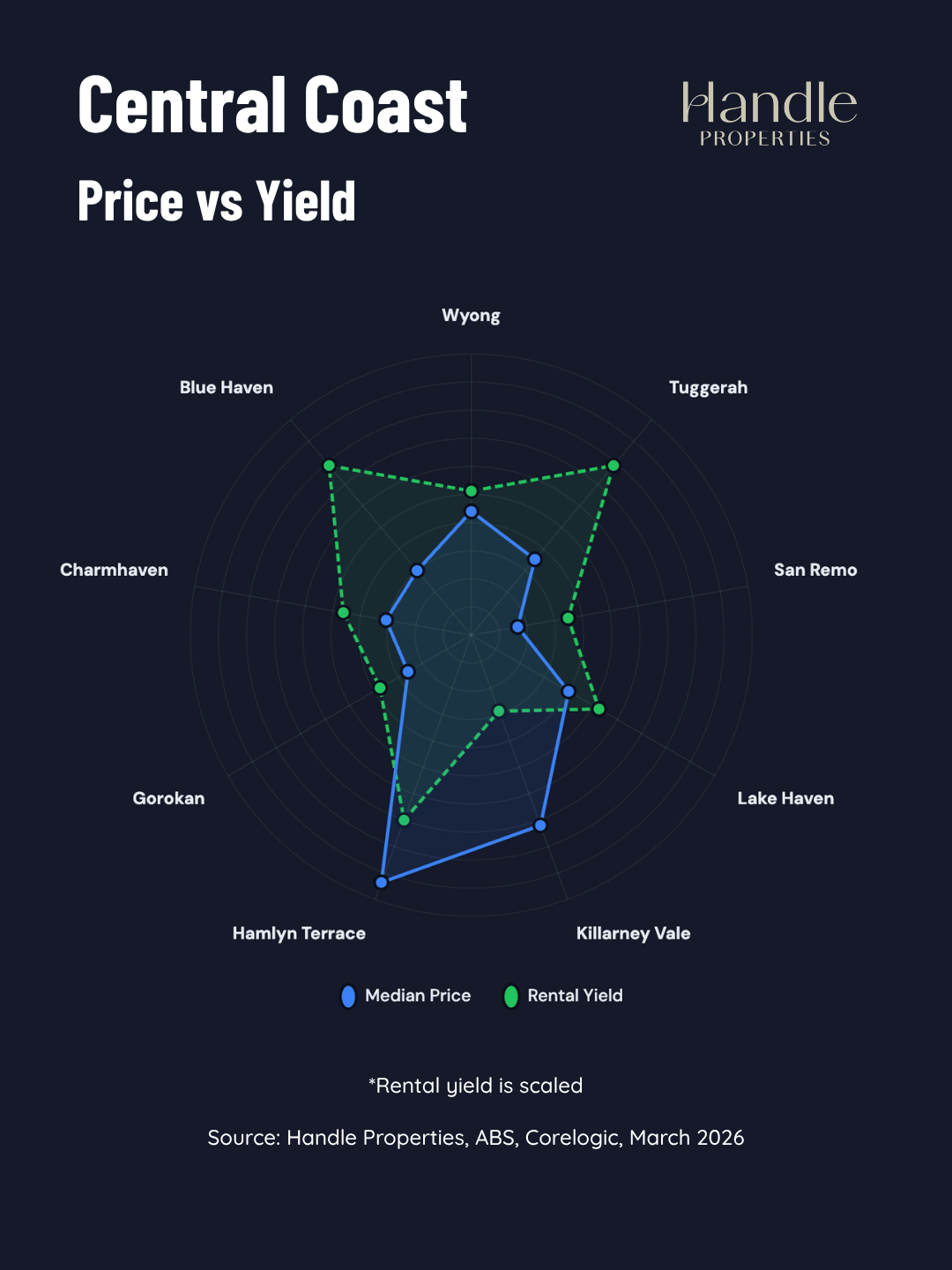
9 Central Coast suburbs. Exposed. We ran the numbers on every suburb between Gosford and Lake Macquarie. Here are the ones that stood out:
View More.png)
Looking for off-market deals, tired of analysis paralysis, or just don’t have time for the legwork? Book a Call!