


Most property buyers in Australia walk into the biggest financial decision of their lives with no professional representation.
The selling agent works for the vendor. The mortgage broker works with the lender. The conveyancer handles paperwork. But nobody at the table is paid to protect the buyer's interests, negotiate on their behalf, or ensure the property they are purchasing actually stacks up as a sound financial decision.
That is exactly what a buyers agent does.
If you have been considering hiring one, or you are not sure whether the fee is justified, this guide breaks down the role, the costs, and the scenarios where a buyers agent delivers a measurable return on investment.
A buyers agent (also called a buyer's advocate) is a licensed real estate professional who works exclusively for the purchaser. They are engaged to find, evaluate, negotiate, and secure property on behalf of their client.
Unlike a selling agent, who is legally obligated to achieve the highest possible price for the vendor, a buyers agent is contractually bound to act in the buyer's best interest. This includes sourcing properties that meet specific investment or lifestyle criteria, conducting due diligence on the asset and the location, and negotiating the lowest possible purchase price.
In Australia, buyers agents must hold a real estate licence or certificate of registration in the state they operate in. They are bound by the same regulatory framework as selling agents, including fiduciary duties and disclosure requirements.
The scope of service varies between agencies, but a full-service buyers agent typically covers five core functions.
This goes well beyond browsing Domain and realestate.com.au. A buyers agent maintains relationships with selling agents, developers, and other industry contacts to access off-market properties before they hit the open market, or that never reach public listing at all.
According to research from Listing Loop, approximately 20% of Australian property transactions occur off-market. In prestige markets, that figure climbs to 40%. A buyers agent with strong local networks can access this inventory, giving their clients first-mover advantage on properties most buyers never see.
A good buyers agent does not just find properties. They evaluate locations using hard data: population growth, income trends, infrastructure pipeline, supply constraints, rental yields, days on market, vendor discounting rates, and historical capital growth.
At Handle Properties, we assess suburbs against 30+ data points before recommending a location. This is the difference between buying where the market has already moved and buying where the data says it is about to move.
Before any offer is made, a buyers agent reviews comparable sales data, building and pest inspection reports, council zoning, flood and bushfire overlays, strata records (where applicable), rental appraisals, and any other factor that could affect the property's current or future value.
This process catches issues that cost buyers tens of thousands of dollars when missed: overquoted prices, undisclosed defects, unfavourable zoning changes, or properties that look good on paper but sit in suburbs with declining fundamentals.
Negotiation is where most buyers agents earn their fee many times over. Selling agents negotiate property deals every week. Most buyers do it once or twice in a lifetime. That asymmetry works against the buyer.
A buyers agent understands vendor motivation, comparable sale benchmarks, auction strategy, and the psychology of property negotiation. They remove the emotional element that causes buyers to overpay, and they use market data to justify offers that land below asking price.
For properties going to auction, a buyers agent sets a maximum bid based on independent valuation, then executes the bidding strategy. This is particularly valuable in competitive markets like Sydney and Melbourne, where auction clearance rates regularly exceed 70% and emotional bidding is the norm.
Buyers agent fees in Australia typically fall into two models.
Percentage-based fees range from 1.5% to 3% of the purchase price, plus GST. On a $1 million property, that is $15,000 to $30,000.
Fixed fees range from $8,000 to $21,000 for a full-service engagement, though premium agencies in Sydney can charge up to $30,000.
Some agencies also offer a search-only or negotiate-only service at a reduced fee, typically $5,000 to $10,000.
The fee structure varies by location. In Sydney, expect to pay 1.5% to 3% or a fixed fee averaging around $14,500. In Perth, the range sits between 1.8% and 2.5%. In Brisbane and Adelaide, fixed fees tend to be lower, reflecting the lower median property prices in those markets.
The key question is not what the fee costs in isolation. It is what the fee saves relative to the negotiation outcome and the quality of the asset purchased.
The answer depends on your situation. A buyers agent delivers the most value in three specific scenarios.
If you are buying in a market you do not live in, you are operating with an information disadvantage. You do not know the streets, the agents, the micro-market dynamics, or the difference between a suburb that is genuinely growing and one that is being marketed hard because stock is not moving. A local buyers agent closes that gap.
A typical property search takes 50 to 100 hours of research, inspections, and negotiations. If your time is worth more than $150 per hour, outsourcing that process to a professional is a rational economic decision.
The difference between a good investment property and a mediocre one compounds over decades. A property that grows at 7% per annum versus 4% per annum on a $750,000 purchase creates a difference of over $400,000 in equity over 15 years. A buyers agent who uses data to select locations, not emotion, can be the difference between those two outcomes.
Not all buyers agents are equal. Before engaging one, check the following.
Licensing. Confirm they hold a valid real estate licence in the state where you are buying. You can verify this through NSW Fair Trading, the Queensland OFT, or the relevant state body.
Independence. Ask whether they receive referral fees or commissions from developers, selling agents, or mortgage brokers. A truly independent buyers agent is paid only by their client.
Track record. Ask for recent case studies and comparable purchase data. A good agent can show you what they paid versus what the property was listed for, and what has happened to values since settlement.
Methodology. Understand how they select suburbs and properties. Are they using data, or are they buying in the same five suburbs as everyone else?
Fee transparency. Get the fee structure in writing before signing an engagement agreement. Understand what is included and what triggers additional charges.
Is a buyers agent the same as a real estate agent? No. A real estate agent (selling agent) represents the vendor and is incentivised to achieve the highest sale price. A buyers agent represents the purchaser and is incentivised to secure the lowest possible price and the best-quality asset.
Can I use a buyers agent for an auction? Yes. Many buyers agents offer auction bidding as part of their full-service engagement. They set a maximum bid based on independent valuation and execute the bidding strategy on your behalf.
Are buyers agent fees tax-deductible? If you are purchasing an investment property, the buyers agent fee is generally included in the cost base of the property for capital gains tax purposes. It is not deductible as an ongoing expense. Always confirm with your accountant.
Do I still need a conveyancer if I use a buyers agent? Yes. A buyers agent handles property search, evaluation, and negotiation. A conveyancer or solicitor handles the legal transfer of ownership. They are separate roles.
How long does it take a buyers agent to find a property? Timelines vary depending on the brief and market conditions. At Handle Properties, most investment property acquisitions are completed within 4 to 8 weeks from engagement.
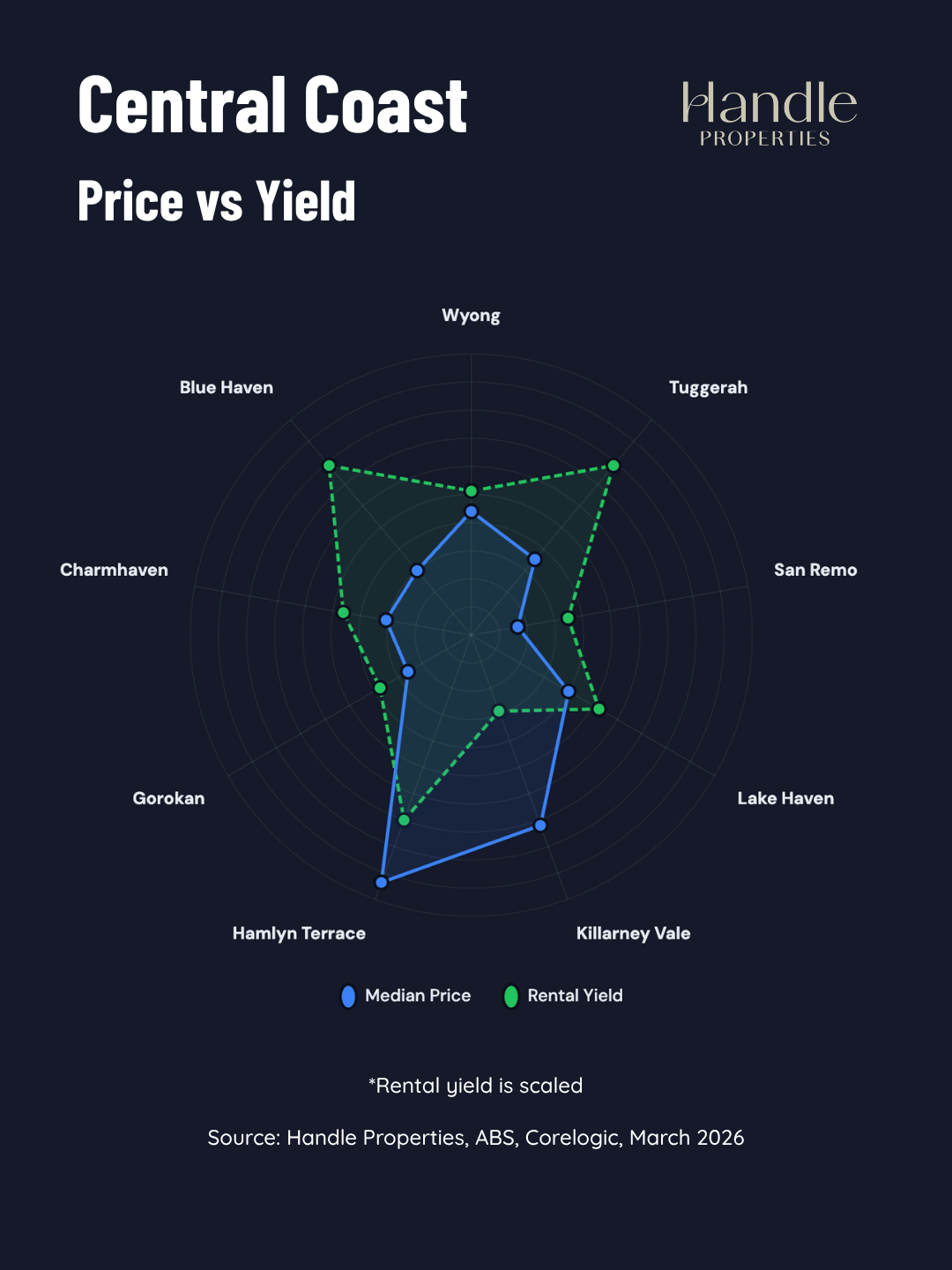

9 Central Coast suburbs. Exposed. We ran the numbers on every suburb between Gosford and Lake Macquarie. Here are the ones that stood out:
View More
Data-driven breakdown of Australia's best investment suburbs for 2026. We analyse population, infrastructure, supply, and yield data across Sydney, Brisbane, Melbourne, Perth, and Adelaide.
View More.png)
Looking for off-market deals, tired of analysis paralysis, or just don’t have time for the legwork? Book a Call!